WELL is the Common Language of Superior Real Estate Performance
How “Investing in Health Pays Back” for Kaiterra, CBRE and Rudin

At the recent WELL Summit in New York City, Dr. Whitney Austin Gray, IWBI’s Senior Vice President of Research, curated three success stories from the WELL community that illustrate the benefits of WELL in their companies’ spaces during her panel, Investing in Health Pays Back.
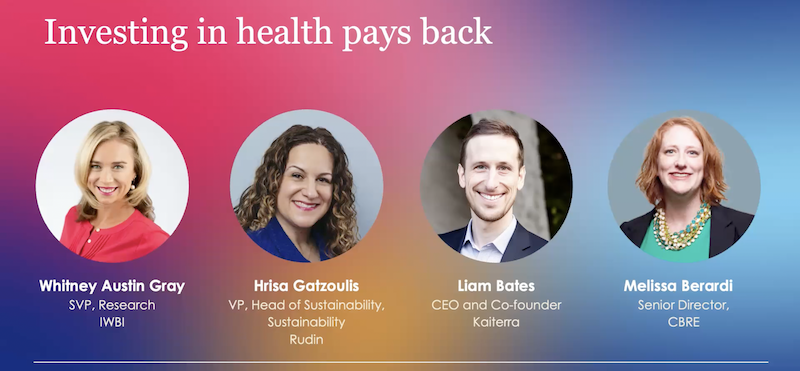
Liam Bates, CEO and Co-founder of Kaiterra, stated that more people fly on private jets than breathe clean air. What percentage of the world actually breathes clean air? Just “0.001%,” said Bates. “Yet no one’s panicking.”
This is because humans as a species, suggested Bates, are bad at risk assessment. Bates reported that 8 million people die annually from unhealthy air (both indoor and outdoor). In New York City, he said, there are 2,700 annual deaths connected to unhealthy air, or eight times the city’s 2025 homicide rate.
Air pollution accelerates dementia and causes damage to unborn children. Yet, he said, we have the solutions to improve our indoor air now. He said doing so would put us in a position to address “the biggest health crisis of our generation.” Improving indoor air quality (IAQ) is a choice, said Bates. “We choose the paint, ventilation system, filtration rates – we create the buildings. If indoor air is losing, that’s not an accident. It’s a design decision.”
The good news is that we can make choices that deliver wins on all fronts. San Francisco International Airport – whose Terminal 1 is WELL Certified Platinum – gains $3 for every $1 it invests into IAQ monitoring. Any space can be retrofitted with sensors, which take just two minutes to install and run for eight years without changing the battery. This makes technology the easy part, according to Bates. And thankfully, more and more companies are choosing to embrace healthy indoor air solutions…
Melissa Berardi, Senior Director at CBRE, helps oversee over 500 locations – 18 of which are WELL Certified Platinum – in over 100 countries, with over 140,000 employees. CBRE is expanding its position as the leading global commercial real estate services and investment firm, defined by its scale and the superior outcomes it delivers for its constituents. The company has influenced more than 49,000 WELL projects since 2013 and is a WELL Enterprise Provider (WELL EP).
In 2026, CBRE expects that workplace experience will continue to drive decisions, and utilization and optimization will be top priorities. CBRE is expanding its commitment with IWBI, leveraging strategic health and well-being investments to deliver superior global real estate performance and unparalleled value for clients and the people inside their buildings. CBRE’s work with IWBI is having impact at scale: buildings that meet the latest standards will have an advantage in terms of tenant demand as occupiers seek healthier, more sustainable office premises to help meet their organizational goals.
Hrisa Gatzoulis is Vice President, Head of Sustainability at Rudin Management in New York City where she improves upon a 100-year legacy of well-being-oriented real estate. Now in its fourth generation of family leadership, Rudin manages a WELL at scale portfolio of 29 office and residential buildings – 11 of which are WELL Health-Safety Rated – comprising over 12 million square feet of space, that affect nearly 30,000 occupants. (Dr. Gray presented Gatzoulis’ presentation in her absence.)
Gatzoulis has seen firsthand how health drives employee focus, decision-making quality and resilience. She’s worked in buildings that have both supported or undermined human well-being. And she sees how prevention is far more powerful than remediation. WELL is a common language at Rudin from governance to benchmarking, permitting data-guided decisions across human resources (HR), design and construction, plus facilities operations and corporate sustainability reporting.
For Rudin, investing in health pays back in its ability to attract and retain better talent, and have more highly engaged and trusting employees who feel a deep sense of belonging at the company. For the business, WELL has brought stronger asset differentiation, risk mitigation and clear benchmarks. Rudin continues to improve its policies and operations with WELL’s guidance, including HR policy updates, two extra wellness days off for all employees, and creating a healthy building material database. WELL’s legacy is long-term value creation, future-proofing buildings and health as part of brand equity.